CSS nth-child selector basics
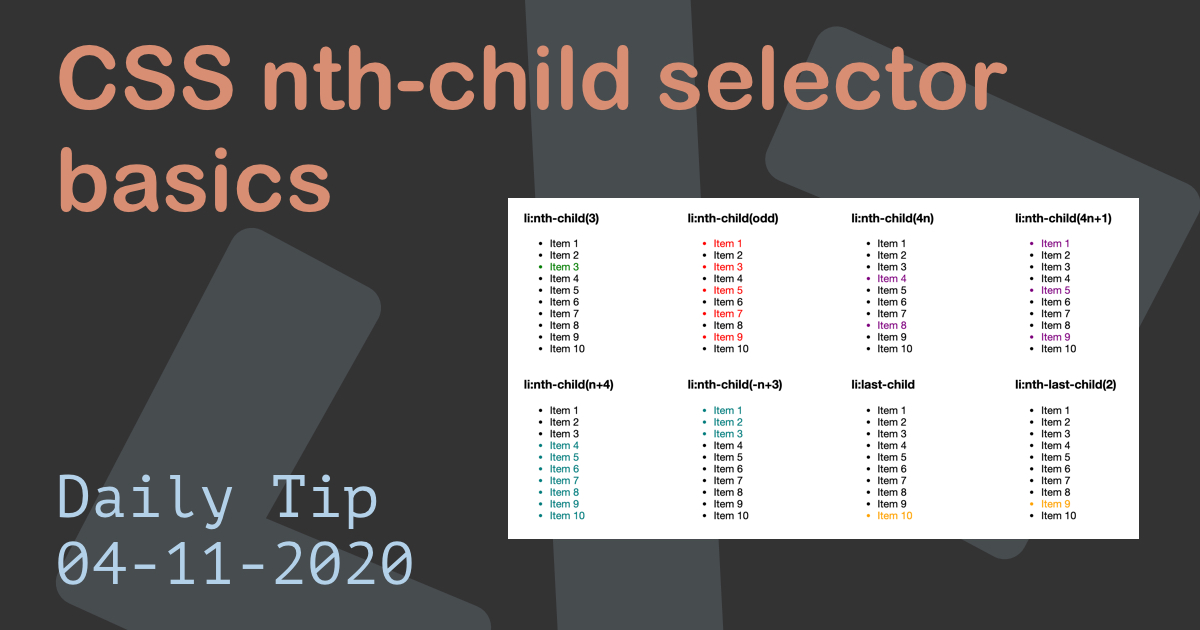
Today we'll be going back to some CSS basics. I tend to use nth-child selectors in my articles.
But that made me realise I haven't really gone over the basics of using nth-child selectors.
Today we will be exploring the options of this powerful CSS selector and some examples.
Nth-child basic selectors
Let's start off by using some basic selectors.
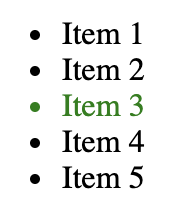
We can define which element we want to select. So lets say we want to select the third item.
<ul>
    <li>Item 1</li>
    <li>Item 2</li>
    <li>Item 3</li>
    <li>Item 4</li>
    <li>Item 5</li>
</ul>
li:nth-child(3) {
    color: green;
}
Result:
Odd/Even selector
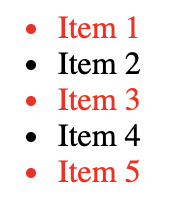
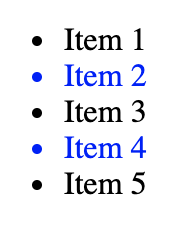
We can select every odd or even code by using these attributes.
li:nth-child(odd) {
    color: red;
}
Result:
li:nth-child(even) {
    color: blue;
}
Result:
Every x selector
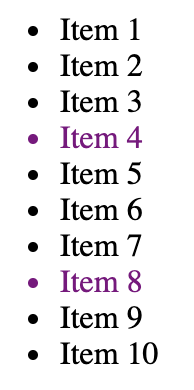
Something cool we do is select every x element, so let's say we want every fourth element:
    li:nth-child(4n) {
    color: purple;
}
Result:
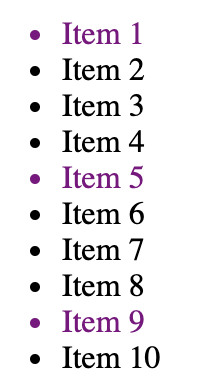
Or if we want to include the first one:
li:nth-child(4n+1) {
    color: purple;
}
Result:
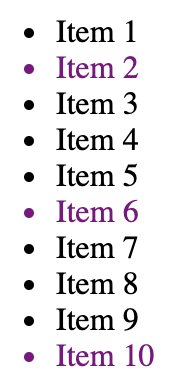
We can also start from the second for instance:
li:nth-child(4n+2) {
    color: purple;
}
Result:
Everything but the first selector
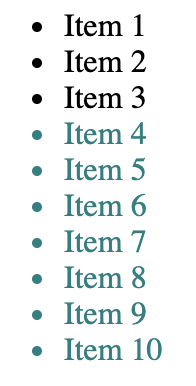
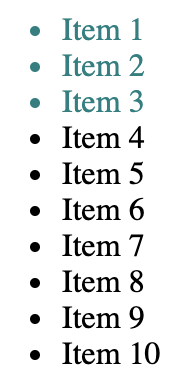
We can even have a selector that states select everything but the first three elements.
li:nth-child(n+4) {
    color: teal;
}
Result:
Only first number selector
Another cool thing we can do it select only the first x amount. Let's get the first three
li:nth-child(-n+3) {
    color: teal;
}
Result:
Selecting the last element
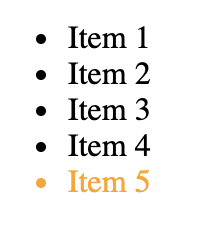
We can even select the last element.
li:last-child {
    color: orange;
}
Result:
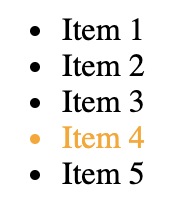
With this, we can also offset to get the second to last one.
li:nth-last-child(2) {
    color: orange;
}
Result:
Combining selectors
We can even combine selectors!
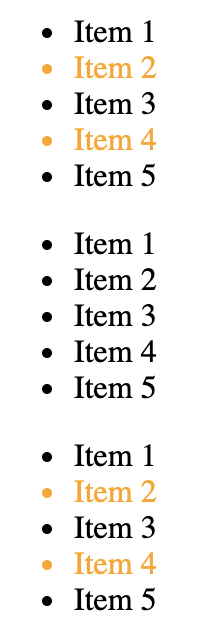
Let's say you want to get every even number from an odd list amount.
<ul>
    <li>Item 1</li>
    <li>Item 2</li>
    <li>Item 3</li>
    <li>Item 4</li>
    <li>Item 5</li>
</ul>
<ul>
    <li>Item 1</li>
    <li>Item 2</li>
    <li>Item 3</li>
    <li>Item 4</li>
    <li>Item 5</li>
</ul>
<ul>
    <li>Item 1</li>
    <li>Item 2</li>
    <li>Item 3</li>
    <li>Item 4</li>
    <li>Item 5</li>
</ul>
ul:nth-child(odd) li:nth-child(even) {
    color: orange;
}
This will get all the odd ul and then all the even li in those.
Result:
Have a play around with this Codepen, try and change some selector to see what happens!
Browser Support
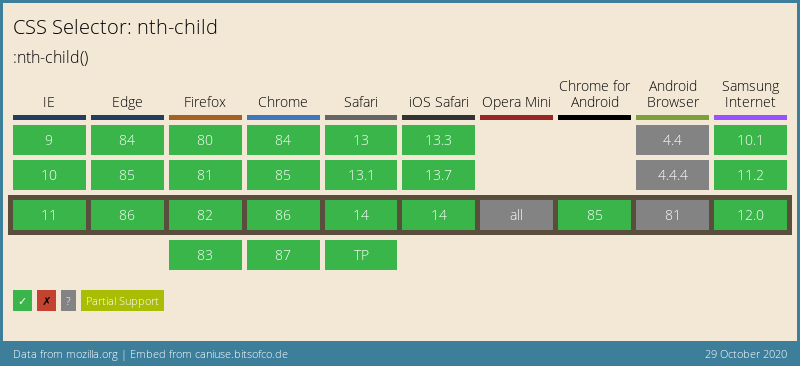
The nth-child selector has really good support and can be used in most of the browsers. Don't hesitate to make use of them.
Thank you for reading, and let's connect!
Thank you for reading my blog. Feel free to subscribe to my email newsletter and connect on Facebook or Twitter
About the author
I'm a full-stack developer from South Africa 🇿🇦. I love writing about JavaScript, HTML and CSS.
Comments
Join the discussionThanks Mazda, I tend to use them quite often (mainly the odd/even), but even the duplicate selectors come in handy.