How to password protect zips on Mac π

I'm a full-stack developer from South Africa πΏπ¦. I love writing about JavaScript, HTML and CSS.
Search for a command to run...

I'm a full-stack developer from South Africa πΏπ¦. I love writing about JavaScript, HTML and CSS.
No comments yet. Be the first to comment.
Most of you know me for my consistency, a golden arrow in my blog series. I've written 1000 articles in 1008 days! Almost an article a day, and my honeymoon was the only holiday I ever took. I'm super proud of this achievement; it has been a fantasti...

It's not the first time I'll be talking about community. I think it's an essential aspect of any successful tool. This shows in my previous explorations of Astro, Medusa, and now Vendure as well. All these products thrive in a super open, welcoming, ...

The cool part about Vendure is how easy it is to set up and how abstract each layer is. Basically, we get the following elements: External database Server Worker Admin UI Frontend While this is amazing, it also brings a bit of complexity when it co...

The previous article looked at customizing Vendure on a data and process level. In this article, we'll look at customizing emails, as they are often a big part of a webshop system. We'll be looking at two different layers of customization for customi...

Even though Vendure is a pretty significant project out of the box, in some cases, we might want to go in and modify some elements to work to our specific use case. In this article, I'll take a high-level look at some elements we can customize within...

If you're on Windows, you might think, but why? Well, Mac doesn't offer a GUI interface for password protecting zips.
Yes, bizarre, right?
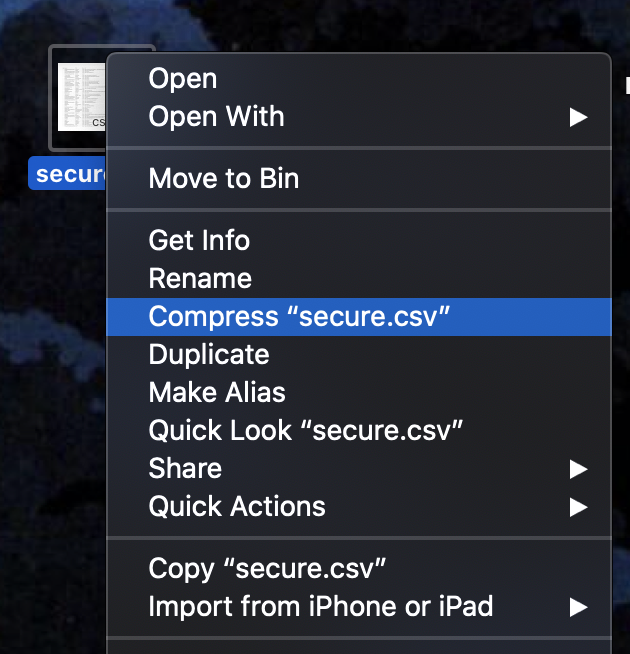
We can right-click a file/folder and compress it into a zip.
But we can, by using our best friend The Terminal password, protect our zip files!
So let's open our favourite terminal program (mine is iTerm2) and enter the following command.
zip -er ~/Desktop/super_secure.zip ~/Desktop/secure.csv
The parameters are as follows:
zip - The actual zip command-er - Encrypt Recursive~/Desktop/super_secure.zip - Output zip name~/Desktop/secure.csv - Input file/folderOnce we run this, we get prompted to type a password.
You don't see any input on these password fields!
Press enter, and you need to verify the password.
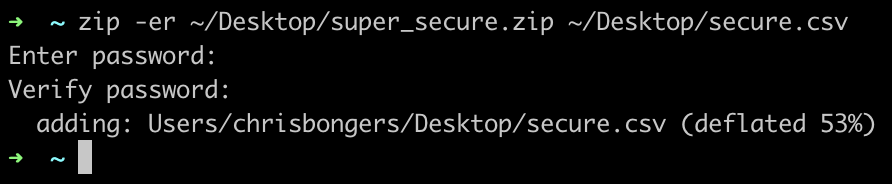
We now created a secure zip.
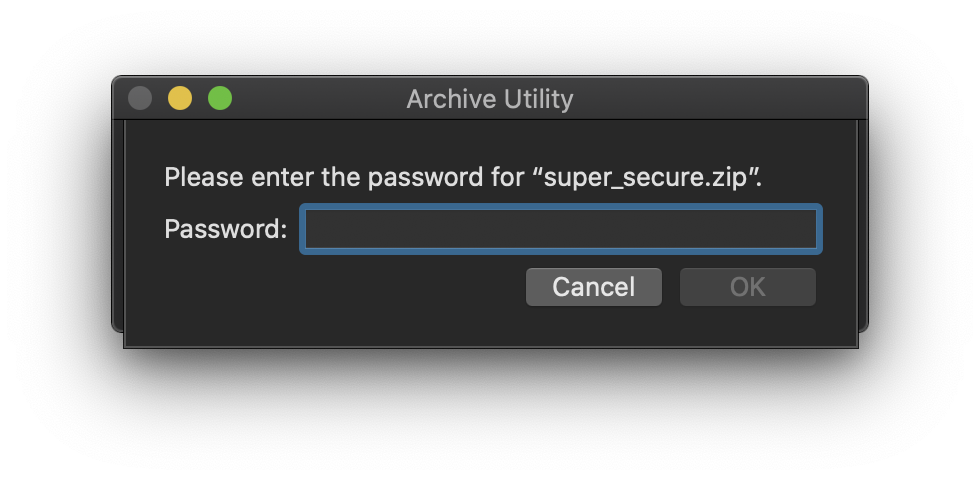
If we try to open this zip, we see the following prompt.
Thank you for reading my blog. Feel free to subscribe to my email newsletter and connect on Facebook or Twitter