Angular adding a token to each API request

Alright, so normally, when we are making API requests, we will need some kind of token to validate our request.
In our case, we just learned how to Log in as a user and ensure the routes are secured.
So from here, how can we manipulate API calls always to include the token we stored in our user object?
We don't want to be adding a header to every object call, like this.
const headers = new Headers({
  'Content-Type': 'application/json',
  'Authorization': `Bearer ${auth_token}`
})
return this.http.get(apiUrl, { headers: headers })
Don't get me wrong. This will work, but it's repeating ourselves, so let's create an interceptor that will do just this for us!
Creating our interceptor
As usual let's open the terminal and find our project folder. Now execute the following command to generate our token interceptor.
ng generate service interceptors/TokenInterceptor
This will create a token-interceptor.service.ts file in our interceptors folder.
import { Injectable } from '@angular/core';
import { catchError } from 'rxjs/operators';
import { Observable, throwError } from 'rxjs';
import { HttpRequest, HttpHandler, HttpEvent, HttpInterceptor } from '@angular/common/http';
import { AuthService } from 'src/app/services/auth.service';

@Injectable({
  providedIn: 'root',
})
export class TokenInterceptorService implements HttpInterceptor {
  constructor(private authService: AuthService) {}
  intercept(
    request: HttpRequest<any>,
    next: HttpHandler
  ): Observable<HttpEvent<any>> {
    const { token } = this.authService.userValue;
    if (token) {
      request = request.clone({
        setHeaders: {
          Authorization: `Bearer ${token}`,
        },
      });
    }
    return next.handle(request).pipe(
      catchError((err) => {
        if (err.status === 401) {
          this.authService.logout();
        }
        const error = err.error.message || err.statusText;
        return throwError(error);
      })
    );
  }
}
So, we register the authService as a provider in our service.
Then we implement the HttpInterceptor from which we will be extending the intercept function.
This intercept function has a request and a next object.
What we do is get the token from our user object. If this is set, we clone the request that is being made and add a header.
In this case, we add a Bearer token with the actual token attached to it (yes, I know this is not an oAuth token)
Then we return the request and catch if we get a 401 (unauthorized) back.
If that is the case, we log out the current user since our token is expired and throw an error back.
Implementing the interceptor
So we now have to make sure all our calls are being logged with this interceptor.
Open up your app.module.ts, and in the providers section add the following.
providers: [
    {
      provide: HTTP_INTERCEPTORS,
      useClass: TokenInterceptorService,
      multi: true,
    },
],
This tells Angular that we made our own HTTP_INTERCEPTOR and which service it should load this from.
Trying out our interceptor
Let's make a quick demo to see if it works.
Open the home.component.ts and make it look as such:
export class HomeComponent implements OnInit{
  currentUser: User;
  constructor(private authenticationService: AuthService, private http: HttpClient
) {
  this.authenticationService.user.subscribe(user => this.currentUser = user);
 }
 ngOnInit() {
   this.getUsers().subscribe(result => {
     console.log(result);
   })
 }
 getUsers() {
  return this.http.get<any>(`${environment.apiUrl}api/users`);
 }
}
We are just doing a simple in component API call with the sole purpose of checking if our interceptor is working.
Now, if you open your console network tab, you should see the following request!
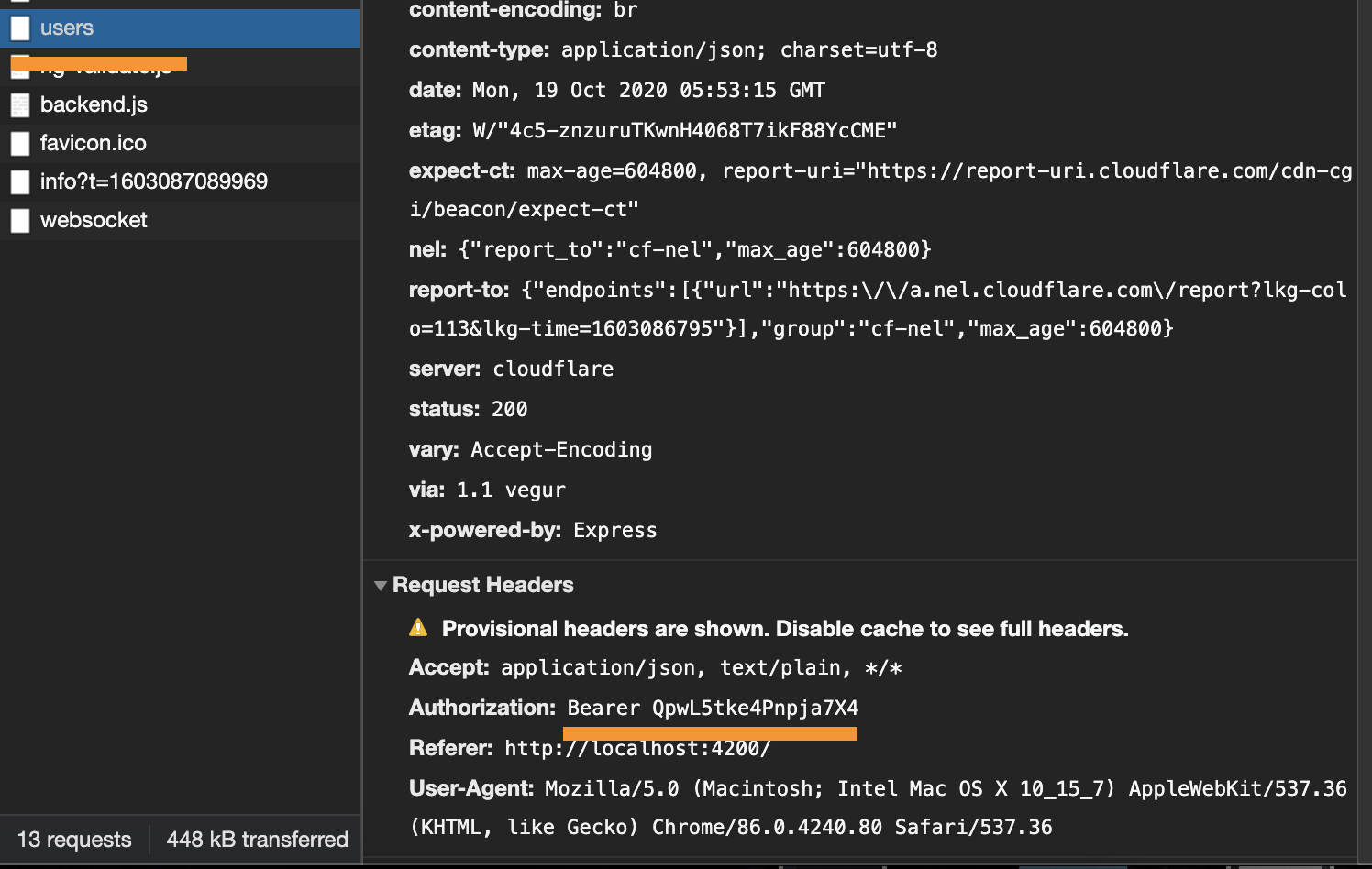
There you go, we now added our own custom header, and it will be added to every single one of our calls.
You can also find this code on GitHub.
Thank you for reading, and let's connect!
Thank you for reading my blog. Feel free to subscribe to my email newsletter and connect on Facebook or Twitter
About the author
I'm a full-stack developer from South Africa 🇿🇦. I love writing about JavaScript, HTML and CSS.
Comments
Join the discussionNo comments yet. Be the first to comment.